Problem
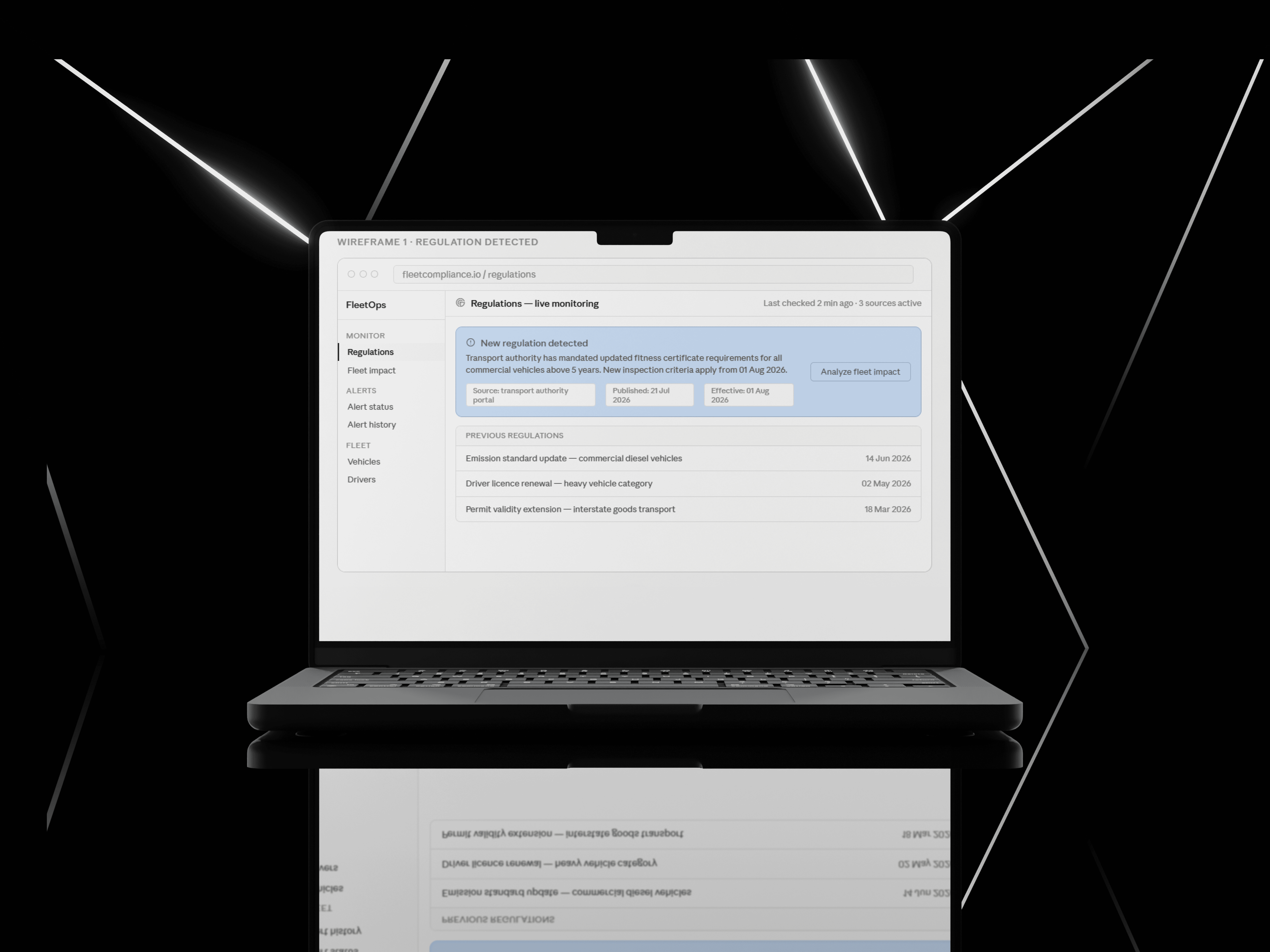
Fleet operators manage compliance across hundreds of vehicles and drivers. Regulations change continuously through transport authority notifications. Existing platforms track documents and send expiry reminders, but when a new regulation is published, compliance teams still manually find it, interpret it, identify affected assets, and coordinate action. Regulatory interpretation remains entirely human.
Impact
By the time a compliance team manually reads a new regulation and reaches the right driver, operations are already at risk. Vehicles get grounded, trips are disrupted, and penalties follow. The gap is not awareness. It is the time between a regulation changing and the right person knowing what to do.
Executive Summary
Fleet management platforms manage documents. This project addresses what comes next: automatically detecting new regulations, translating them into fleet-specific impact, and alerting the right people before operations are affected.
Discovery
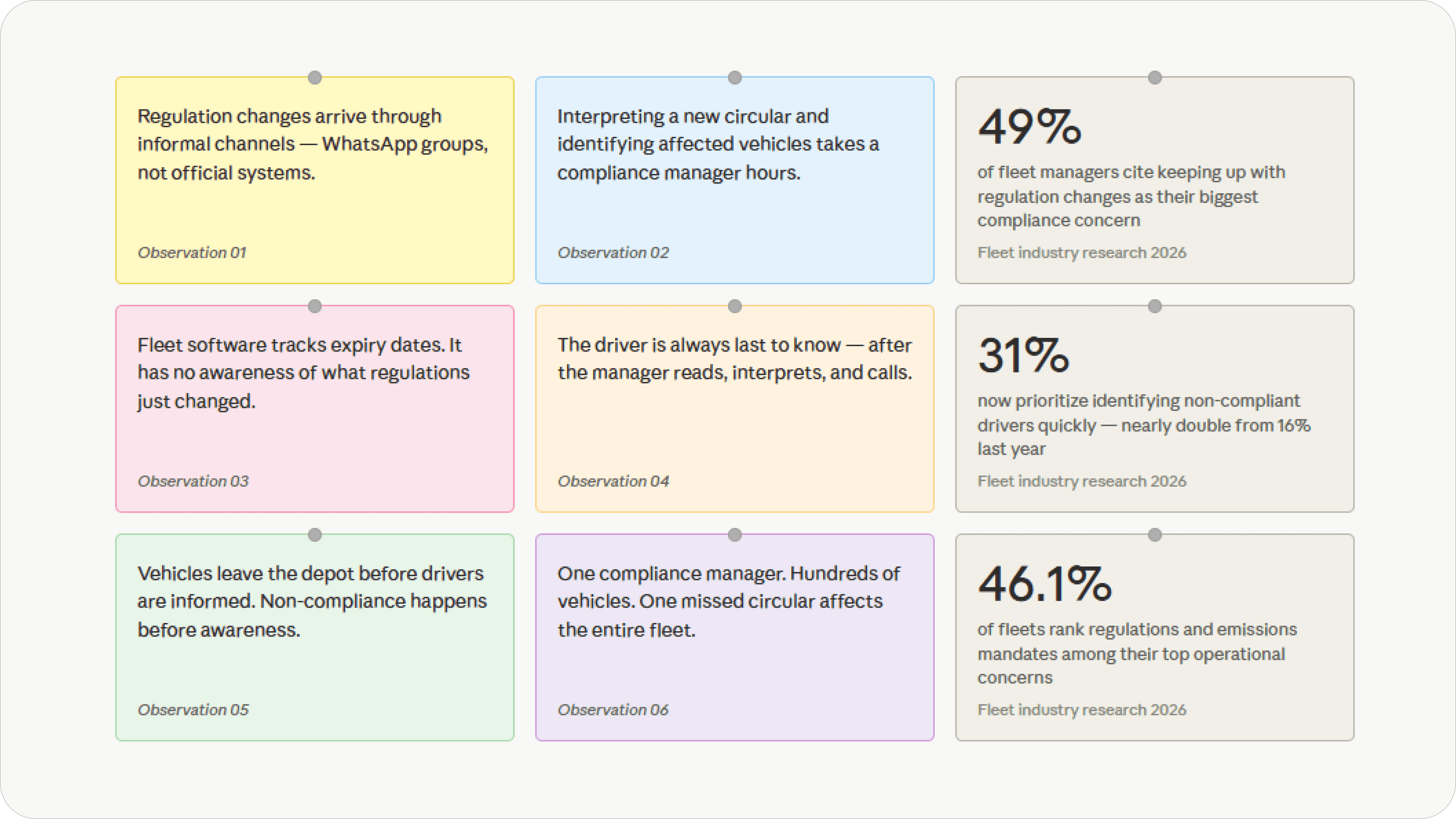
Field research with a fleet compliance manager confirmed the gap. One person manually monitors all documents daily. Regulatory updates arrive through a committee channel and are manually cross-referenced against fleet records. The driver is always the last to know.
Key Product Decisions
Decision 1
Automatic regulatory monitoring vs manual interpretation
Why
Regulations change without warning. Interpretation sits entirely with one person.
Decision
The system detects new regulations the moment they are published and cross-references them against existing fleet records..
Trade-off
Dependency on portal structure in exchange for eliminating manual tracking entirely.
Decision 2
Simultaneous alerts vs single-point notification
Why
One notification recipient creates delay and a single point of failure.
Decision
Alerts go simultaneously to the affected driver and fleet operator with what is affected, what action is needed, and by when.
Trade-off
Requires platform access for both parties in exchange for eliminating the manual coordination layer.
Design Direction
Policy Impact Analyzer with Proactive Alerts
When a new regulation is published, the system detects it, reads it, and cross-references it against fleet records. The compliance manager receives a fleet-wide impact summary. Simultaneously, affected drivers and their fleet operators receive direct alerts specifying the document or vehicle issue, the regulation that triggered it, and the action required.


Outcomes
Users quickly understood which vehicles and drivers were affected by a new regulation.
The Policy Impact Analyzer reduced the need to read lengthy government circulars.
Simultaneous alerts to drivers and operators were considered useful for avoiding communication delays.
Action completion tracking was added after users flagged they could not tell whether compliance issues had been resolved after alerts were sent.
Reflections
Notifying someone is not the same as resolving the problem.
One recipient is never enough when compliance requires action from multiple people.