Product Designer · Full Ownership
SaaS
B2B

Problem
Homeowners and their interior designers couldn't tell whether feedback had been seen, addressed, or which design version was current, because the review loop ran across two disconnected platforms and side channels like WhatsApp, email, and calls.
Why it mattered
Both sides coordinated on assumptions. Homeowners chased updates while designers lost half their day to follow-ups, and trust eroded the longer a decision stayed invisible.
Executive Summary
Asian Paints offers homeowners a service where interior designers reimagine their space. Designers work in Foyr and push renders to the Asian Paints app, where homeowners review and respond. The two run on separate interfaces, so the entire review cycle depended on manual coordination. This project connected both ends into one visible, trackable collaboration.
Discovery
Interviews with homeowners and designers surfaced three pain points that shaped the design direction.
Neither side could tell if feedback had been seen or acted on.
No reliable way to know which design version was current
Coordination scattered across WhatsApp, email, and calls

Key Product Decisions
Decision 1
Explicit progress states vs implicit progress (homeowner end)
Hypothesis
If each design and comment carries a visible status, homeowners will stop chasing updates.
Why
Homeowners couldn't tell if feedback had been seen or acted on.
Decision
Give every comment and version a clear state and owner, visible on the render itself.
Trade-off
Added process overhead for designers and homeowners who previously communicated informally.
Decision 2
Visible version history vs minimal interface (designer end)
Hypothesis
If client annotations land in one place tied to version and room, designers will stop maintaining separate tracking.
Why
Designers tracked revisions in side sheets and lost time triaging feedback.
Decision
Route every annotation into a Foyr inbox grouped by project, version, and room, pinned in context on the render.
Trade-off
More interface density than a plain canvas.
Design Direction
Building on these decisions, the flow made the full review loop visible to both sides, from a homeowner's comment to the designer's rework and back.

1. Structured Collaboration & Progress Visibility
Shared status timeline: Each design moved through clearly defined review states, making feedback status and ownership visible without manual follow-ups.
Structured feedback & annotations: Feedback was captured directly on designs, ensuring comments were traceable and reducing ambiguity during review cycles.
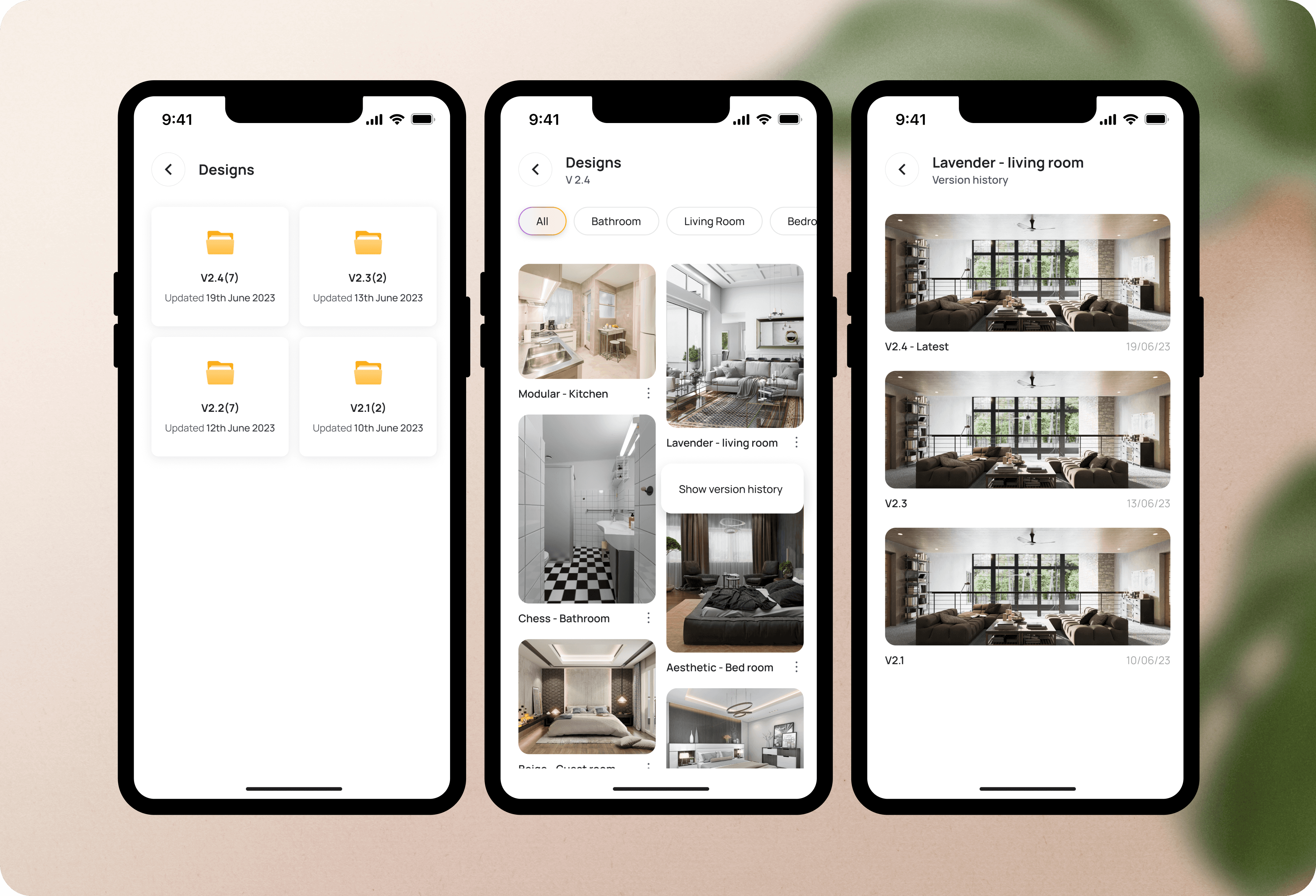
When progress had no visible form, stakeholders filled the gap with assumptions. A timeline gave the review cycle a shape everyone could read without asking.

3. Designer Workflow & Feedback Resolution
Grouped annotation inbox: Client comments arrived organised by project, version, and room, so designers saw what needed action without separate tracking sheets.
In-context rework: Designers opened each annotation pinned on the render, reworked it, and pushed the version back, advancing its status.
The shift was from triage to action. Bringing feedback into one place, tied to the exact version and room, let designers act on what mattered instead of hunting across scattered messages.

Outcomes
Behavior Change
Explicit review states cut the need for clarification messages during review cycles.
Version tracking removed the backtracking between design iterations.
The grouped inbox replaced the separate tracking sheets designers kept.
Workflow Gains
Structured states brought designers and homeowners into alignment faster.
Clear ownership at each stage reduced manual coordination after reviews.
In-context rework cut the follow-up time lost to scattered feedback.
User Confidence
Visible progress signals let homeowners move forward without repeated reassurance.
A single source of version truth gave both sides confidence the loop was moving.
Reflections
This project reinforced that collaboration problems are rarely communication problems. They are visibility problems.
How I would approach this differently today
What Changed In My Thinking
The turning point in this project was identifying that the problem was visibility, not communication. That distinction took time to surface through manual synthesis across multiple stakeholder observations.
What I Observed
Revisiting this with NotebookLM, the same framing emerged immediately, with patterns clustered across uncertainty, invisible progress, and ambiguity of responsibility.
What This Means Going Forward
Getting to a clear hypothesis faster means less time in the wrong solution space.